

Review · WALKING TOURS
Secrets of Central London Walking Tour
Central London can feel like one big blur. This walking tour slows things down, using London Transport Museum archive stories to connect street scenes with transport engineering from the 1500s to today, and even explains why trains sound near quiet Embankment Gardens. I love the way it turns familiar areas like Covent Garden and Kingsway into a living map of how London moves, and I also like the focus on practical, real infrastructure clues, from the Thames as an early public thoroughfare to the tunnel network around Holborn. One possible drawback: the pace and spoken English can feel fast, so if your English is limited, you may miss details.
You’ll be walking for up to two hours through busy parts of Theatreland, Covent Garden, Kingsway, and the Embankment. The route is designed for learning on foot, not for sitting down, and it includes uneven ground and road crossings, so sturdy shoes and patience with crowds are key.
In This Review
- Key things to notice on this Hidden London walking tour
- First impressions: a transport tour that walks like a mystery
- Meeting outside London Transport Museum (Covent Garden Piazza) and what to expect
- Theatreland and Covent Garden: from Convent Garden to streets that shaped transport
- Kingsway and Theatreland transport secrets you can spot while walking
- The Thames story: London’s first public transport thoroughfare
- Holborn’s underground tunnels: the “lots of stuff under you” lesson
- Embankment Gardens: why you hear trains in a tranquil spot
- Crossrail and the 2010s: modern change built on older streets
- Price and value: is $26 a good deal for 2 hours?
- Pace, language, and comfort tips so you don’t miss the good parts
- Who this tour suits best (and who should skip it)
- Should you book the Secrets of Central London Walking Tour?
- FAQ
- How long is the walking tour?
- Where does the tour meet?
- What is included in the price?
- What language is the guide speaking?
- Does the tour include disused tube stations?
- What should I bring?
- Are luggage or large bags allowed?
- Is the tour suitable for children?
- Is the tour accessible for wheelchair users?
- Can I cancel if plans change?
Key things to notice on this Hidden London walking tour

- London Transport Museum archive stories that connect old street origins with modern lines and works
- The Thames as a first public transport thoroughfare, framed in a way you can actually picture
- Holborn’s underground tunnels, explained as part of everyday city planning
- Kingsway Tram Tunnel and Piccadilly line construction, tied to streets you will pass
- Embarkment Gardens, trains you hear anyway, plus the practical reason behind it
- A tight 2-hour format that focuses on walking and conversation, not museum entry
First impressions: a transport tour that walks like a mystery

I like tours that make you look up, not just forward. This one does that with a simple premise: London’s transportation story is not hidden in a vault. It is built into the streets you already think you know.
You start near the London Transport Museum in Covent Garden, and the walk moves through Theatreland and key transport corridors, with regular stops where the guide explains what you are looking at and what lies underneath. The focus stretches from older roots in the 1500s to major modern systems and projects, including Crossrail work in the 2010s. The payoff is a clearer mental map of how London became the city it is today, line by line, tunnel by tunnel.
More Walking Tours in London
- Magical London: Harry Potter Guided Walking Tour
★ 4.7 · 22,044 reviews - London: The Original Jack the Ripper Walking Tour
★ 4.7 · 7,833 reviews - London: Harry Potter Movies Walking Tour (Kids Go Free)
★ 4.7 · 3,071 reviews
Meeting outside London Transport Museum (Covent Garden Piazza) and what to expect
You meet outside the main entrance of London Transport Museum, Covent Garden Piazza, WC2E 7BB. Plan to arrive about 15 minutes early because a member of the Hidden London team meets you before the start.
A few practical notes matter here:
- The tour lasts about 2 hours, and it’s real walking, not a short stroll.
- There is no cloakroom, so keep your load light. The tour does not allow luggage or large bags.
- You should bring a passport or ID card.
Even if you are excited to learn, you’ll enjoy it more if you treat it like an active city walk. The route includes uneven ground and frequent road crossings in busy areas, so sturdy footwear and clothing that works for weather changes will keep you comfortable and focused.
Theatreland and Covent Garden: from Convent Garden to streets that shaped transport
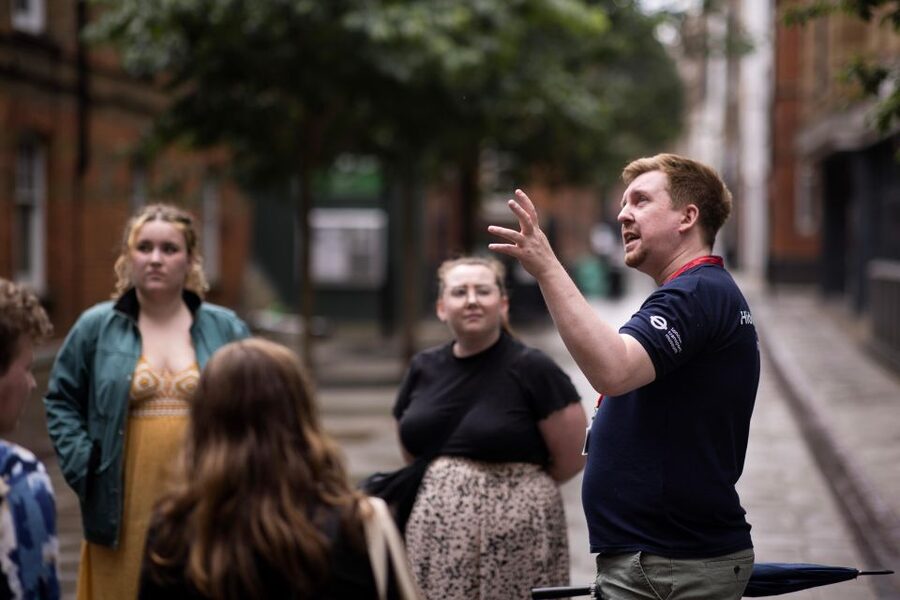
Covent Garden is one of those areas where you can spend a day without noticing much beyond shops and performers. This tour nudges you to see the infrastructure side of the story.
You’ll learn about Covent Garden as it was originally known, and you’ll hear how the area’s early theatres helped create the crowds and movement patterns that later demanded better transport connections. The idea is not that theatres invented transit, but that public gathering spots shape where transit systems grow and how streets get used.
One of the fun parts of this segment is the way “culture” and “movement” get tied together. The oldest shop in the city also comes into the conversation here, and the guide uses those anchor points to show how the area’s commercial life worked alongside the expanding transport network.
Why this matters for you: if you’ve ever felt that London’s transit history is too abstract, this is a good bridge. It puts names and dates into the kind of places you can still walk through today. You’ll leave with a stronger sense of why certain routes and corridors became important, because you’re connecting them to real daily pressure points: crowds, entertainment, commerce.
Kingsway and Theatreland transport secrets you can spot while walking
As the walk moves toward Kingsway, the tour starts doing something I really value: explaining how street planning and transport planning overlap.
You’ll hear about how well-known streets shaped London’s transport systems. That might sound broad, but the tour grounds it in specific examples. Kingsway Tram Tunnel is one, and the Piccadilly line is another. The guide frames them as engineering feats that were tied to where people needed to go, and to the physical challenges of threading new routes through an existing city.
This is also where you may notice how London keeps layers of movement. Even when you stand at street level today, you’re standing above parts of the story that were built earlier, updated later, and repurposed over time. The tour encourages you to think vertically as well as horizontally.
A small reality check: this walk is not set up as a slow, stop-and-photo museum experience. You’re absorbing information while moving through busy streets. If you like to read every sign and linger, you may feel a little rushed during the densest parts.
Same corner of Britain, a different sort of outing:
- London: The London Eye Entry Ticket
★ 4.6 · 35,875 reviews - London: Tower of London and Crown Jewels Exhibition Ticket
★ 4.6 · 28,769 reviews - From London: Harry Potter Warner Bros Studio Tour
★ 4.7 · 26,588 reviews - London: Westminster to Greenwich River Thames Cruise
★ 4.5 · 22,836 reviews
The Thames story: London’s first public transport thoroughfare
The tour highlights the Thames as London’s first public transport thoroughfare. That’s a surprisingly useful way to think about transit, because it reframes “transport” as more than rail and buses.
From the guide’s angle, the Thames is an early network. People traveled along it, businesses depended on it, and the river shaped where activity concentrated. Then, as land transit systems grew, the river remained a central organizing feature of the city.
Why I think this is good for you: even if you only ever ride the Tube or walk, you start recognizing why London’s center developed the way it did. When you understand the river as a transport spine early on, later rail corridors and cross-city links make more sense. You’re not just collecting facts, you’re building a framework.
Holborn’s underground tunnels: the “lots of stuff under you” lesson
Holborn gets singled out for a very specific reason: you’ll hear about the multitude of tunnels underground in that area.
This is where the tour stops feeling like general history and starts feeling like practical city understanding. London does not just have transit above ground. It has layers of movement and infrastructure that have been built, modified, and woven into neighborhoods over time. Holborn is one of those places where the city’s underground footprint becomes part of the story you are trying to decode.
You also learn about the engineering feats that shaped modern transport, without sending you into any disused tube stations or hidden chambers. That last part is important. The tour is designed to explain what’s around you and under you without turning into a cave tour.
Consideration: the tour involves uneven ground and busy streets, so this “underground” topic is mostly delivered as context and clues. If you want hands-on access to underground spaces, the tour does not do that.
Embankment Gardens: why you hear trains in a tranquil spot
Here’s one of those London moments that feels personal even when you didn’t plan it. Embankment Gardens can look calm while the city roars. This tour explains why trains running can be heard while walking there.
The value is in connecting a sensation you already noticed, or might notice, to the system behind it. You stop treating it like background noise and start understanding it as a predictable result of how lines run through the city center.
It also helps you appreciate the geography of the transport network. The city’s quieter pockets and its loud transit corridors are not separate worlds. They share the same space, often within sight and sometimes within the same view.
Crossrail and the 2010s: modern change built on older streets
The walk does not stay stuck in the past. You’ll hear about work to build Crossrail in the 2010s, and the broader theme is how modern transport projects get shaped by older street patterns.
The guide links modern works to long-term city planning, including the way existing roads and corridors influence what can be built. Crossrail is used as a case study, not just a name drop, so you can understand it as part of the continuing evolution of London’s transit.
This is one of the reasons I think the tour’s time box works. It’s 2 hours, so it cannot cover everything. But it does enough to give you a timeline feel, older transport ideas leading into the later rail era, and that rail era continuing into contemporary construction like Crossrail.
Price and value: is $26 a good deal for 2 hours?
At about $26 per person for a roughly 2-hour guided walk, the value depends on what you want.
If you like transport history, this price is reasonable because you get:
- A live guide
- A focused walk through multiple central neighborhoods
- Specific stories tied to named transport projects like Piccadilly line and Kingsway Tram Tunnel
- Clear explanation of major themes, from the Thames to modern Crossrail-era work
What you do not get is also part of the value equation. Entry to London Transport Museum is not included. And the tour does not visit disused tube stations or spaces. So you are paying mainly for the guide-led walk and the archive-based storytelling, not for an indoor museum experience or underground access.
I’d say this is good value if you enjoy learning while walking and you want to connect transit systems to real streets. If you want museum time, station-by-station exploration, or quiet, low-effort sightseeing, you may prefer a different format.
Pace, language, and comfort tips so you don’t miss the good parts
One honest consideration from a review experience: the tour can be spoken quickly, and that can be tough if your English is limited, especially when you’re moving. This matters, because the tour is built on details pulled from archives. If you fall behind, the story can get harder to follow.
So I’d do two things before you go:
- If your English is not strong, arrive with a clear expectation that the tour is information-dense and mostly spoken.
- Keep your energy up so you can concentrate, not just catch up with the group.
For comfort:
- Wear sturdy footwear because the tour includes uneven ground.
- Wear clothes appropriate for weather, since you’re outdoors the whole time.
- Skip bulky items, because there’s no cloakroom and large bags are not allowed.
Who this tour suits best (and who should skip it)
This walking tour works especially well if you:
- Want a short, guided way to understand Central London’s transport development
- Like engineering stories tied to places you can still see
- Enjoy history that connects street names, tunnels, and transit lines rather than just dates
It may not be the best match if you:
- Need slow, fully seated pacing
- Want disused tube station visits, because the tour does not do that
- Travel with small children, since it is not suitable for children under 9
Wheelchair access is listed, but mobility impairment suitability is also listed as not suitable. Since the tour includes uneven ground and road crossings, you should treat this as a sign to check carefully whether the route fits your needs before booking.
Should you book the Secrets of Central London Walking Tour?
Yes, if you want a high-impact Central London experience in about two hours, with strong transport themes and specific engineering stories tied to real places. The tour is especially appealing if you like the idea of understanding London from street level and learning why what you hear and see makes sense.
I would only pass if you know you struggle with fast spoken English, you cannot handle sustained walking and road crossings, or you specifically want the London Transport Museum interior or disused underground stations. In those cases, the format will likely frustrate you.
If you’re flexible and comfortable walking, book it. This is the kind of tour that changes how you interpret the city after you finish, because the next time you hear trains near Embankment Gardens, or pass through Kingsway, you’ll have the story behind it.
FAQ
How long is the walking tour?
The tour lasts about 2 hours.
Where does the tour meet?
Meet outside the main entrance of London Transport Museum, Covent Garden Piazza, WC2E 7BB.
What is included in the price?
You get the guided walking tour for approximately 2 hours. Entry to London Transport Museum is not included.
What language is the guide speaking?
The tour is in English.
Does the tour include disused tube stations?
No. This tour does not visit disused tube stations or spaces.
What should I bring?
Bring a passport or ID card.
Are luggage or large bags allowed?
No. Luggage or large bags are not allowed. Also, there is no cloakroom.
Is the tour suitable for children?
It is not suitable for children under 9 years.
Is the tour accessible for wheelchair users?
Wheelchair accessible is listed, but the tour is also listed as not suitable for people with mobility impairments. The walk involves uneven ground and road crossings.
Can I cancel if plans change?
Free cancellation is available up to 24 hours in advance for a full refund.
Newly listed near London
- Women in art – National Gallery★ 5.0 · 3 reviews
- Woking: Royal Horticultural Society Wisley Garden Ticket★ 4.7 · 24 reviews
- Windsor Stonehenge Bath Private Tour from London with Passes★ 4.8 · 5 reviews
- From London: Windsor, Stonehenge & Oxford Private Car Tour★ 3.5 · 4 reviews
- Windsor Castle Tour with Fish and Chips Lunch in London★ 4.4 · 25 reviews
- Windsor Castle & Hampton Court Palace VIP Black Taxi Tour★ 4.9 · 14 reviews
- London: Windsor Castle & Tower of London Tour with Tickets★ 3.3 · 15 reviews
- From London: Windsor Castle, Bath, and Stonehenge Day Trip★ 4.4 · 153 reviews
Walking Tours, compared.

Magical London: Harry Potter Guided Walking Tour
Read our review →

University and City Walking Tour with Alumni Guide
Read our review →
Harry Potter Movies Walking Tour (Kids Go Free)
Read our review →
The Great British Rock and Roll Music Walking Tour
Read our review →
Jack the Ripper Walking Tour – Ripper Vision Tours
Read our review →
Browse the lists this tour appears in