
Review · BRISTOL TOURS
St Mary Redcliffe Church Bristol: Guided Tour
St Mary Redcliffe is one of Bristol’s great churches, and the tour is how you start noticing it all. You move from the hexagonal North Porch to key chapels, then into hidden spaces normally off-limits, with stories that connect the building to sea voyages, wealthy merchants, and even poetry. I especially like how the guide keeps you looking up and sideways, not just straight ahead.
Two things I really like: the focus on medieval details you might miss on your own (graffiti, carvings, monuments, and that 14th-century stained glass), and the way the tour links architecture to real people and events, like Cabot’s voyage and the lightning collapse that reshaped the church. One possible drawback to plan for is the Chatterton Room at the top, which is reached by a 75-step spiral staircase and is not accessible if stairs are a problem.
If you want a church visit that feels like a guided walk through centuries, this one delivers. It is also short enough to fit easily into a Bristol day, while still covering multiple “wow” stops inside one building. Just be ready for some stairs at the end, and you’ll get a lot for the $8 ticket price.
In This Review
- Key highlights you should know
- Getting oriented inside St Mary Redcliffe’s North Porch
- The outside carvings and the tower and spire views
- Sea connections inside: Cabot, the whalebone, and the Matthew model
- St John’s Chapel and 14th-century stained glass that holds up close
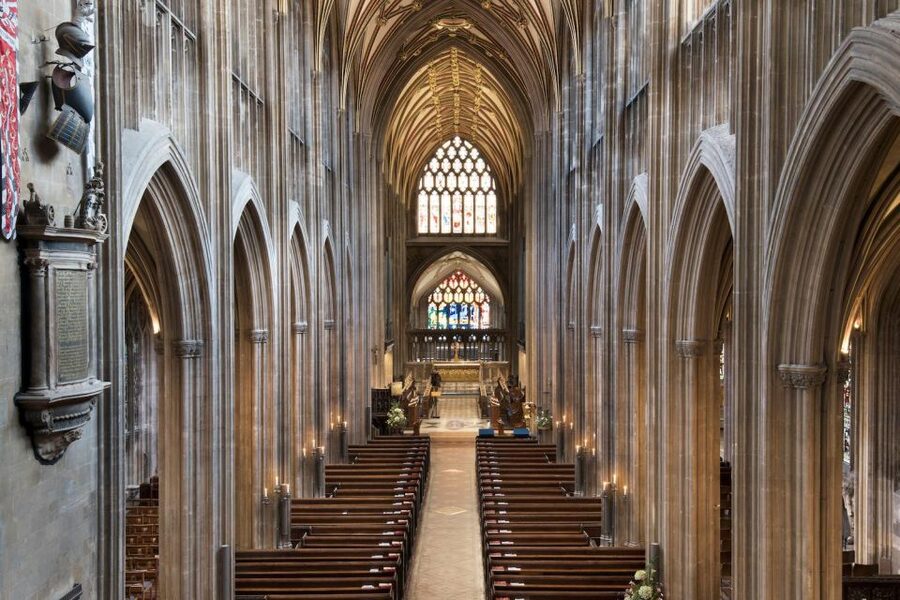
- The west end view: altar, chancel, and 1,200 roof bosses
- North Transept effigy mystery and Robert de Berkeley’s water story
- Lady Chapel screen and Harry Stammers stained glass from the 1960s
- South Transept merchant prince tombs and the lightning-spire chapter
- Medieval graffiti, merchants marks, and why guides matter here
- Hidden above the North Porch: the Chatterton Room climb
- Guides you might meet, and how the experience feels in practice
- Price and time: why $8 for 90 minutes feels fair
- Who should book this St Mary Redcliffe guided tour
- Should you book it?
- FAQ
- How long is the guided tour of St Mary Redcliffe Church?
- Where do I meet the guide for the St Mary Redcliffe tour?
- Is the tour in English?
- How much does the tour cost?
- Does the tour include hidden spaces normally closed to the public?
- Is the Chatterton Room accessible if I cannot climb stairs?
Key highlights you should know
- Hexagonal North Porch kickoff, once the main chapel and tied to a Virgin Mary shrine
- Medieval stone carvings and the church’s famous tower and spire outside
- Cabot’s whalebone connection to Bristol’s maritime story inside
- St John’s Chapel stained glass from the 14th century
- Over 1,200 roof bosses plus perpendicular Gothic views from the west end
- Chatterton Room hidden above the North Porch, reached by a 75-step spiral staircase
Getting oriented inside St Mary Redcliffe’s North Porch
Your tour starts where most people never linger long enough. You meet inside the church near the main entrance by the visitor’s desk, then head straight to the hexagonal North Porch, dating from the 12th to 13th centuries. The key idea here is that this porch was once the main chapel area, and it even held a shrine to the Virgin Mary.
This first stop sets the tone for the whole visit. Instead of treating the church like one finished masterpiece, you see it as layers, repairs, and changing roles over time. It also helps you read the building from early on, because the porch geometry and age give you a reference point for everything you see later.
Practical tip: take a minute to look at the porch shape and carvings before the guide moves on. Once you start getting pulled toward stained glass and monuments, it is easy to lose that early context.
A few more Bristol days worth comparing
- Bristol: Blackbeard to Banksy Guided Walking Tour
★ 4.9 · 1,422 reviews - From Bristol: Stonehenge and Cotswold Villages Day Tour
★ 4.8 · 717 reviews - Bristol: Air Raid Shelter & St. Nicholas Market Walking Tour
★ 4.8 · 320 reviews
The outside carvings and the tower and spire views
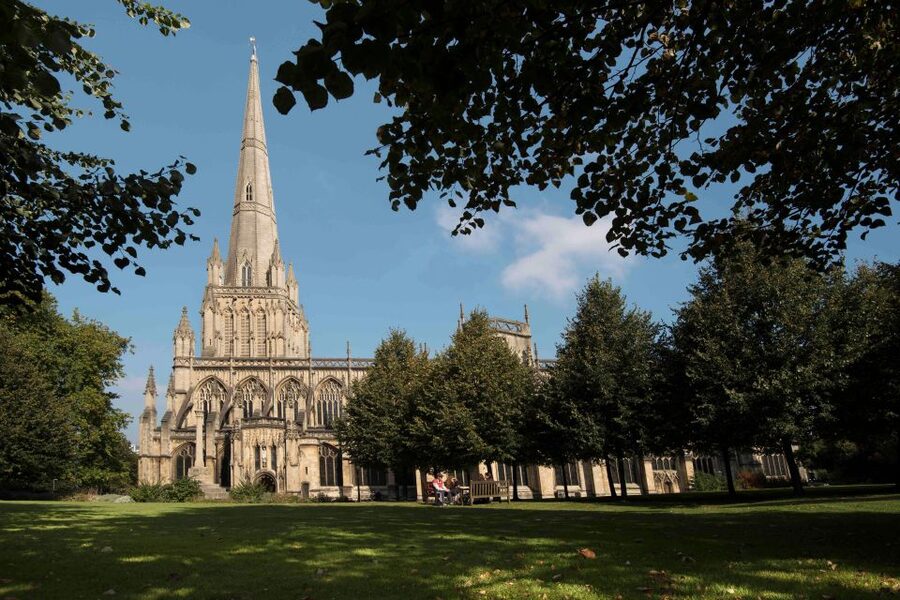
After the porch, you step outside to look at the stonework and the exterior character of the church. The standout value of this moment is how the guide points out the exquisite and mysterious stone carvings on the porch exterior. These are the kinds of details that fade fast when you rush, but on a guided walk, you get direction for what to notice.
You also get a solid look at the tower and spire, which is one reason St Mary Redcliffe is so closely associated with Bristol’s skyline and identity. Even if you have seen the church from a distance before, it is different when you are standing at a human scale and hearing how the building changed through the centuries.
If the weather is bad, this segment can still work, since you are outside only briefly, but wear something comfortable. Stone churches make temperature swings feel bigger than you expect.
Sea connections inside: Cabot, the whalebone, and the Matthew model
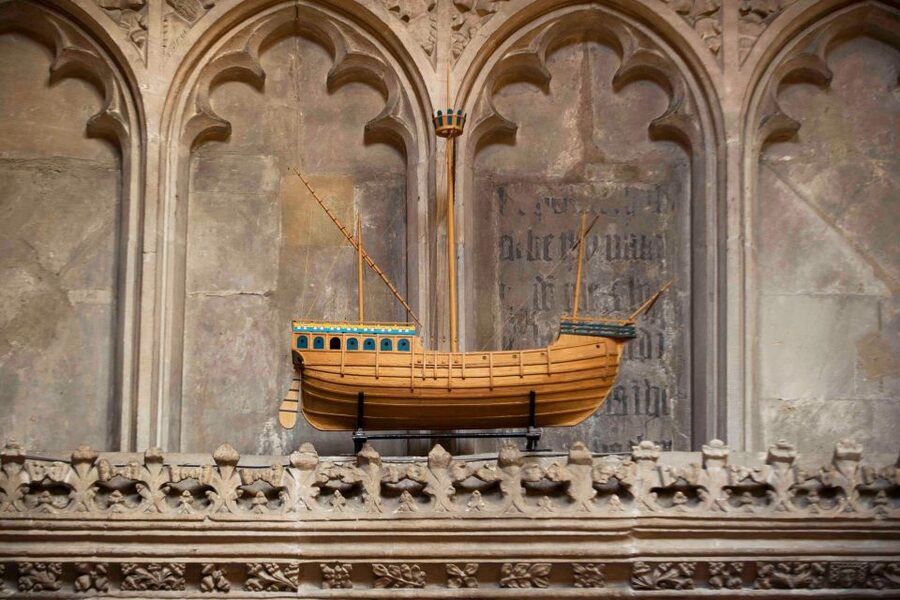
Inside again, the church turns toward Bristol’s maritime links. One of the tour’s best “wait, what?” moments is the whalebone associated with John Cabot’s 1497 voyage to North America on his ship, the Matthew. On the tour, you do not just hear the name, you get the sense that this is how a church collected and displayed stories of the wider world.
The guide also connects the maritime theme to an existing display above the main entrance, a model connected to Cabot’s ship. This matters because it shows you how St Mary Redcliffe is not only about local devotion, but also about global exploration, commerce, and pride.
For you, this section is a mental shift. You start seeing the church as an information hub for Bristol, not only a worship space. If you like history that feels specific, not abstract, you will probably enjoy how the tour ties an object to a named voyage.
St John’s Chapel and 14th-century stained glass that holds up close
Next comes St John’s Chapel, where the focus is medieval art and design. The highlight here is the church’s remaining medieval stained glass, dating from the 14th century. This is the kind of stained glass that rewards a slower look, because the details are often easier to read when someone tells you what era you are seeing and how it fits the building’s development.
If you have only ever glanced at stained glass while walking through cathedrals, this stop is where the tour corrects that habit. You get a clear reason to pause, and you get a sense of why these pieces survived while other elements of churches changed or disappeared over time.
Note to plan for: lighting can be uneven inside. If you bring glasses or have trouble reading fine details, keep your head up and angles in mind, so you can catch the patterns and colors as the guide gestures.
Same corner of Britain, a different sort of outing:
- From Bristol: Oxford and the Cotswolds Full-Day Tour
★ 4.7 · 244 reviews - Bristol: Guided Ghost Tour
★ 4.8 · 193 reviews - Bristol: Wake The Tiger Amazement Park Entry Ticket
★ 4.3 · 156 reviews - Bristol: Self-Guided Sightseeing Audio Tour
★ 4.4 · 151 reviews
The west end view: altar, chancel, and 1,200 roof bosses
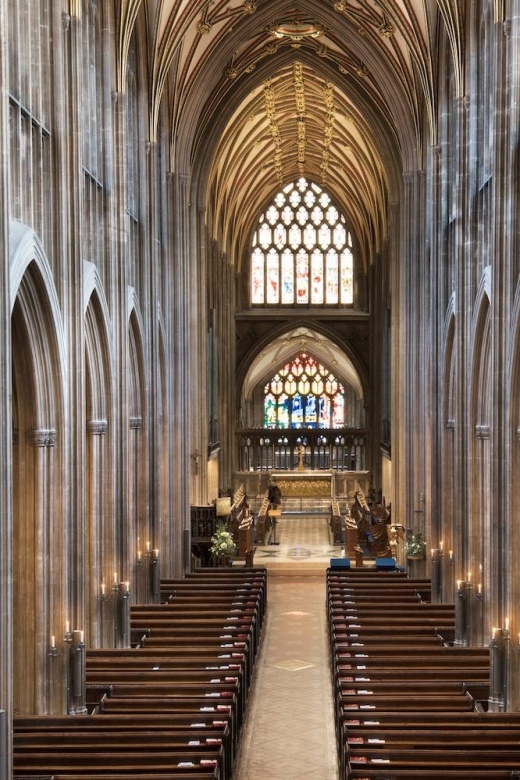
At the west end, the tour builds toward one big visual payoff. You stand so you can take in the view toward the chancel and altar, then look upward at the vaulted ceiling with over 1,200 individual roof bosses. Roof bosses sound technical until you see them as carved points in the space, each one part of a larger design rhythm.
You also get to marvel at the soaring pillars and the church’s standing as one of the finest examples of English Perpendicular Gothic architecture. The value of this moment is not just the wow factor. It helps you understand what “Perpendicular” means in real space, meaning tall vertical emphasis, strong structure, and a visual pull that guides your eye.
When a guide times this moment well, it feels like the church “clicks” into focus. You realize you are looking at a structure meant for height, light, and attention, even though the building grew over many centuries.
North Transept effigy mystery and Robert de Berkeley’s water story
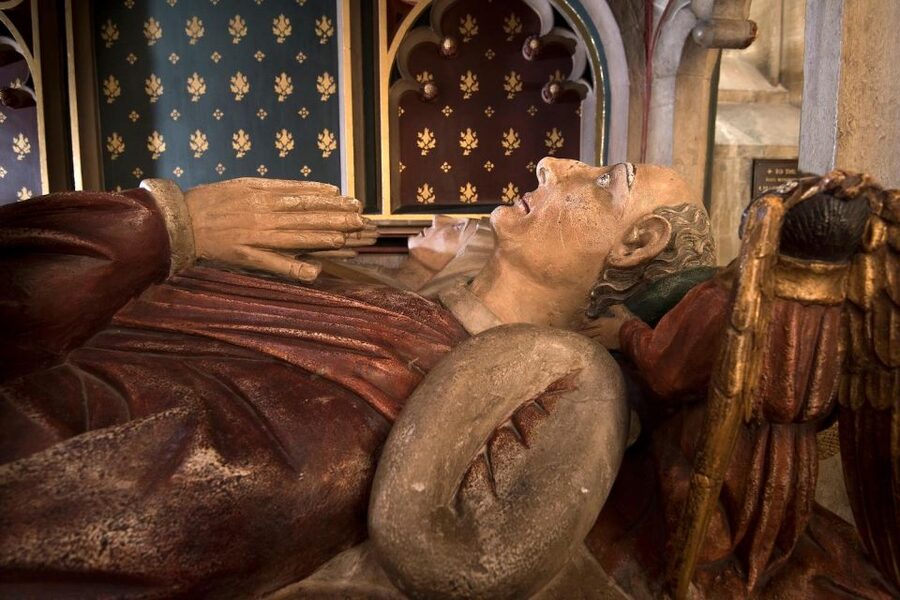
In the North Transept, you run into an enigmatic stop: an effigy of an early medieval knight. What makes it stand out on this tour is the uncertainty. The figure has long been associated with Robert de Berkeley, who gave a water supply to the church in 1190, but nobody really knows who the effigy represents.
Even better, the tour frames the mystery in a believable way: the figure is probably older than the church building itself. That single idea, that you might be looking at something that predates the current structure, makes the effigy feel like a thread tying the site to an earlier Bristol.
If you like legends that are supported by hints rather than certainty, you will likely enjoy this stop. It is also a nice change of pace after the more celebratory medieval art moments.
Lady Chapel screen and Harry Stammers stained glass from the 1960s
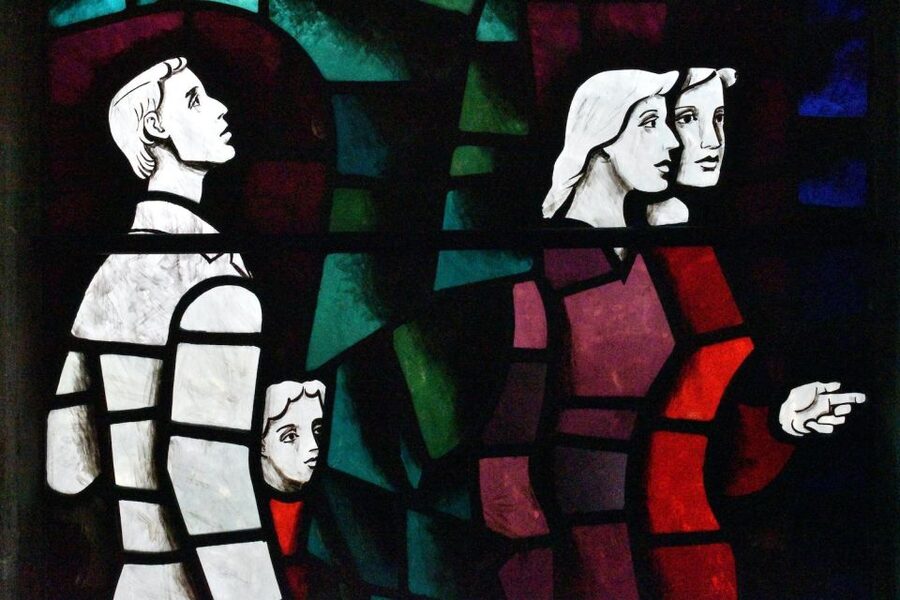
Then you head to the 14th-century Lady Chapel, where the guide brings you into another important layer of the church’s long life. The highlight is the gothic screen plus stained glass windows designed by Harry Stammers in the early 1960s.
This detail matters for how you see the church. People often assume medieval churches are frozen in the past, but St Mary Redcliffe shows continued care and adding of art long after the Middle Ages. Seeing 1960s design paired with medieval architecture helps you understand that heritage is a living process, not a sealed museum case.
One practical takeaway for your visit: treat this chapel like a “dialogue” between eras. Look at how the modern windows sit within older stone geometry, and you will get more out of the sight than just admiring color.
South Transept merchant prince tombs and the lightning-spire chapter
In the South Transept, the mood shifts toward wealth, civic power, and rebuilding. Here you see the polychrome stone altar tomb of William Canynges II and his wife Joan. The tour connects Canynges to Bristol’s political and commercial life, including roles as MP and Mayor.
Then comes one of those story hooks that makes the stones feel active: Canynges is credited with rebuilding the church in the 15th century after the spire was hit by lightning, collapsed, and destroyed part of the nave. That sequence of disaster and rebuilding is exactly the sort of event that explains why churches look the way they do today.
If you enjoy learning how wealthy merchant families left their mark on places of worship, this is likely your favorite section. It also gives context to why certain monuments and tombs are placed where they are, so you are not just looking at names, you are understanding why names matter.
Medieval graffiti, merchants marks, and why guides matter here
As the tour moves around the church, the guide pulls attention to artworks, carvings, effigies, and monuments. This is also where you get the tour’s most “only on a guided walk” value: medieval graffiti and merchants marks that have adorned the walls for about 800 years, now being discovered.
On your own, you might see scratches and marks and assume they are random wear. On this tour, you get a framework for reading them as part of how people used the space, worked nearby, and left traces over generations.
In other words, the tour teaches you to look like the building is speaking back.
Hidden above the North Porch: the Chatterton Room climb
The finale is one of the most memorable parts: a hidden space high above the North Porch, called the Chatterton Room, associated with Bristol’s boy poet Thomas Chatterton (1752 to 1770).
But here is the planning reality. Access is via a flight of stairs, a 75-step spiral staircase, so the Chatterton Room is not accessible for anyone unable to climb. The tour is built so that most of the visit happens in the main body of the church, which is accessible via the south entrance and on a level. The operator welcomes bookings from those who cannot visit the Chatterton Room, so you can still join for the main parts.
If stairs are difficult for you, consider bringing this up early so you can join the accessible portion without pressure. If stairs are fine, this stop feels like a reward for paying attention all the way through the tour.
Guides you might meet, and how the experience feels in practice
This tour runs with live English-speaking guides, and the difference between a good church talk and a great one shows up fast. In recent visits, guides such as Bryan and Paul stood out for pacing and the way they answered questions without rushing people through.
One very specific bonus showed up in at least one tour experience: Bryan Anderson opened a large cope chest inside the church, and there was also an organ demonstration, with guests getting to hear how the instrument works. If you are the type who loves hearing a place come alive with sound, that kind of moment can add a lot, even though it is not something I would assume will happen on every single run.
The key is that the guides do not just recite dates. They point you to objects and help you connect them to the stories you hear.
Price and time: why $8 for 90 minutes feels fair
At $8 per person for a 90-minute guided walk, this tour is strong value, mainly because you are not only seeing the obvious parts of a famous church. You are paying for guided interpretation and for access to hidden spaces normally closed to the public, plus focused stops on medieval stained glass, carved stonework, monuments, and the Chatterton Room.
In plain terms, the ticket is cheap compared to what you usually pay for a timed church access experience where you get a guided route and special viewing. The duration also helps. You get a full circuit without feeling trapped for hours, so it fits well with other Bristol plans.
Who should book this St Mary Redcliffe guided tour
You should book if you like church history that stays concrete, with objects you can point to and stories tied to named people. It is especially a good fit if you care about medieval architecture, stained glass, and the human side of a building, like merchants leaving marks and benefactors shaping what gets rebuilt.
You might want to skip or plan carefully if you cannot manage stairs, because the Chatterton Room requires climbing a 75-step spiral staircase. The rest of the church can still be visited at a level route, but the hidden-room finale is the part that many people remember most.
Should you book it?
Yes, if you want a short, high-value way to understand why St Mary Redcliffe is so important, and you enjoy looking at details with a guide directing your eyes. This tour is at its best when you are curious about how medieval art and later additions sit inside one evolving building.
If you are comfortable with stairs, the Chatterton Room makes the experience feel special, like you earned access. If stairs are not an option, you can still join for the main body of the tour, just know that the upstairs space is not part of that accessible route.
FAQ
How long is the guided tour of St Mary Redcliffe Church?
The tour lasts 90 minutes.
Where do I meet the guide for the St Mary Redcliffe tour?
You meet inside the church near the main entrance by the visitor’s desk.
Is the tour in English?
Yes, the tour is in English.
How much does the tour cost?
The price is $8 per person.
Does the tour include hidden spaces normally closed to the public?
Yes. The tour includes access to hidden spaces that are normally closed, including the Chatterton Room.
Is the Chatterton Room accessible if I cannot climb stairs?
No. The Chatterton Room is only accessible via a flight of stairs, a 75-step spiral staircase. The main body of the church is accessible, and the tour welcomes bookings from those unable to visit the Chatterton Room.
Newly listed near Bristol
- From Bristol: 4-Day Cornwall, Devon & Stonehenge Tour★ 4.3 · 22 reviews
- Bristol: Bristol Zoo Project Entry Ticket★ 4.3 · 18 reviews
- Bristol: Wake The Tiger Amazement Park Entry Ticket★ 4.3 · 156 reviews
- Bristol: Upside Down House Entry Ticket★ 3.8 · 32 reviews
- Bristol: The Best Of Bristol, Guided Bike Tour★ 4.8 · 68 reviews
- Bristol : Sightseeing Custom Tour with a Local Guide★ 3.9 · 6 reviews
- Bristol: Self-Guided Sightseeing Audio Tour★ 4.4 · 151 reviews
- Bristol: The House Magicians Comedy and Magic Show★ 4.7 · 37 reviews
Bristol Tours, compared.


Air Raid Shelter & St. Nicholas Market Walking Tour
Read our review →
Browse the lists this tour appears in