
Review · HISTORICAL TOURS
Liverpool: Theatrical History Tour and The Dead House
Liverpool has a way of keeping secrets, and this one is under your feet. You’ll do a theatrical walking tour that walks you across Liverpool’s older bones, then funnels you into The Dead House, a subterranean morgue that has been closed to the public for over a century.
What I like most is the access. You’re not just hearing about the dead house, you’re getting an exclusive look at the underground space tied to some grim local history. I also love how the guides use street-theater style storytelling, so the city streets feel like a live performance rather than a slideshow. One consideration: this is not for people with a delicate stomach or anyone who struggles with mobility, because the tour includes an underground entry and steps.
In This Review
- Key highlights in plain terms
- Starting at Queen Victoria Monument, then walking the seven streets
- Theatrical street technique: how the guides make alleys feel like scenes
- Liverpool Town Hall and Castle Street banking halls: the bright face before the dark one
- Nelson Monument and the commercial district lanes that turn the mood
- Entering The Dead House: the subterranean morgue under Church of Our Lady and St Nicholas
- Torch required, and why that rule is part of the experience
- Family-friendly with limits: adults, kids, and what not to bring
- Is it good value at $26 for an underground morgue experience?
- Should you book the Liverpool Dead House theatrical history tour?
- FAQ
- How long is the tour?
- Where does the tour start and end?
- Do I need to bring a torch?
- Is The Dead House open to the public?
- Can unaccompanied minors join?
- Is the tour wheelchair accessible?
Key highlights in plain terms

- Exclusive subterranean access to The Dead House morgue, in a location that has stayed closed for decades
- Street-theater style storytelling that brings Liverpool’s original seven streets to life as you walk
- Real landmarks in the route, including Liverpool Town Hall, Nelson Monument, and Castle Street
- A dark finale in a medieval garden setting, entered through a trapdoor beneath a Gothic spire
- Audience participation and staged drama, with actors in full character throughout
- Bring your own torch, because you’ll need it for the underground portion
Starting at Queen Victoria Monument, then walking the seven streets

You start at the Queen Victoria Monument in Derby Square, then it’s straight into a guided route that lasts about 1.5 hours. The pace is on-foot and built for story telling. You’ll be stopping, listening, and moving again, so good shoes matter more than chasing perfect photos.
What makes this format work is the way the walk supports the plot. The tour doesn’t treat Liverpool like a list of sites. It treats the city like a set, with turns and side streets used to shift the mood. Along the way, you’ll hear about the city’s earlier layout and see how the older street pattern still shapes where you stand now.
The route is short on paper, but it does pack in a lot. There are multiple walking segments, plus guided stops at major landmarks. If you’re hoping for a leisurely stroll with time to wander off, plan for a more scripted experience.
More History Tours in Liverpool
- Liverpool: Haunted History Guided City Tour
★ 4.9 · 404 reviews - Liverpool: A Walk Through Time: Full History Walking Tour
★ 4.8 · 184 reviews - Liverpool: St James’ Cemetery Historical Ghost Tour
★ 4.9 · 169 reviews
Theatrical street technique: how the guides make alleys feel like scenes
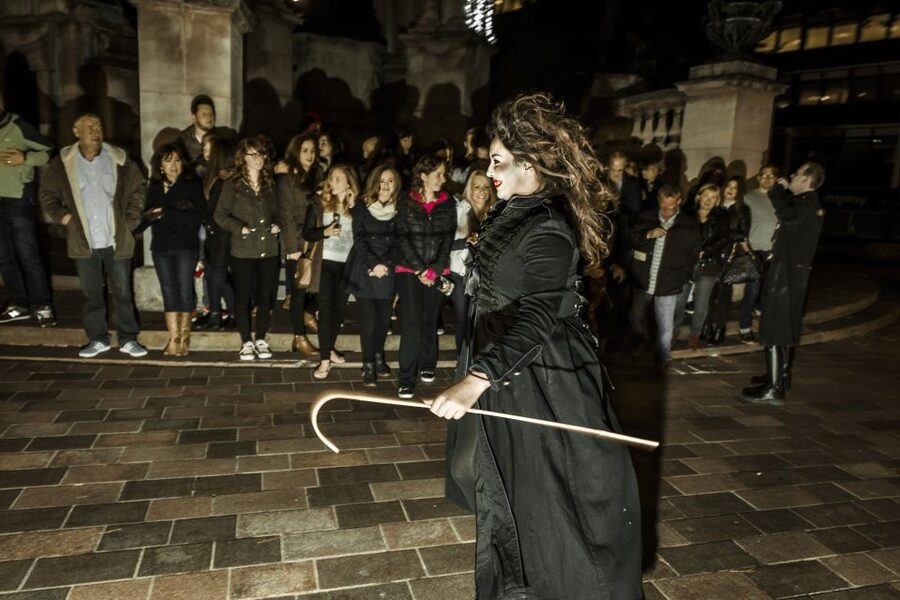
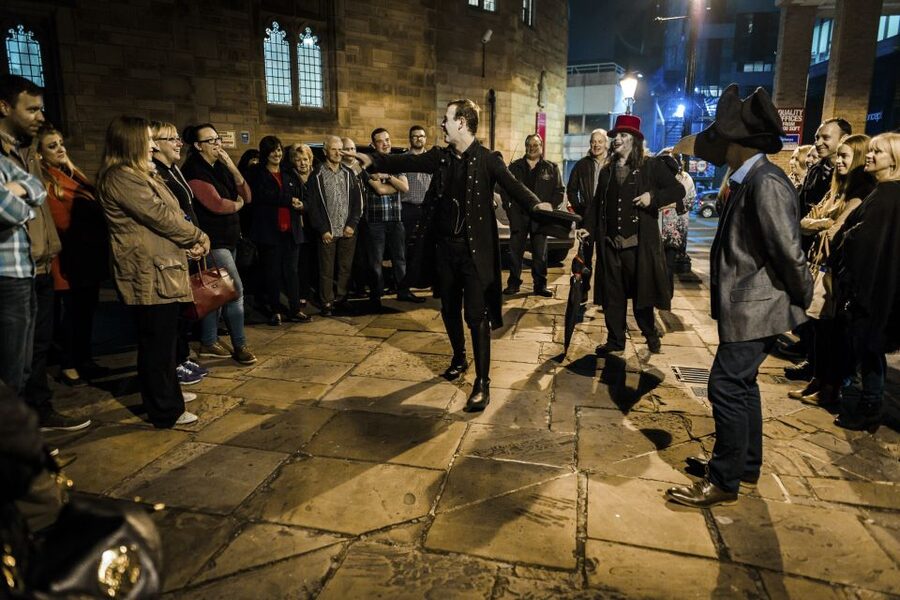
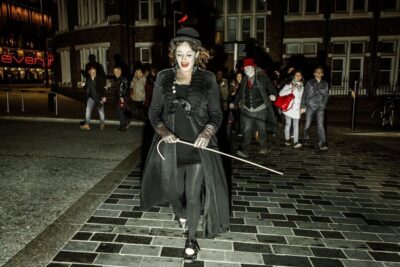
This tour uses street theater techniques, meaning the guide and actors do more than narrate. They act, coax, pause you at the right corners, and keep you focused on what the city looked like when it was being lived in day to day.
This is where the tour earns its top ratings. The tone tends to be funny, theatrical, and tightly controlled, with a strong sense of timing. In the crowd, you can expect audience participation, and it often feels more like joining a show than being lectured.
You’ll also cover the city’s original seven streets concept, which matters because it frames Liverpool’s growth as a human-scale place, not an abstract map. The point is to see how narrow streets, banking halls, and commercial lanes all fit together into one neighborhood story.
One more reality check: while it’s theatrical, it is not set up as a full-on paranormal night. If you want nonstop ghost scares, you might find the drama leans more into storytelling, mood, and history than constant haunting.
Liverpool Town Hall and Castle Street banking halls: the bright face before the dark one

The tour’s midpoint energy turns on contrast. You’ll get regal, formal architecture before you head toward darker corners. Liverpool Town Hall is part of the guided stops, and you’ll also hear about Castle Street and its lofty banking halls.
That matters because it shows Liverpool’s two sides, prosperity and grit, in the same walk. It’s a useful way to read the city. When you know why a place looked confident on the outside, you understand why the darker spaces below could exist without breaking the city’s public image.
Town Hall also helps you reset your bearings. After walking older lanes and hearing about the city’s early layout, you get a clear, landmark-sized moment to orient yourself. This keeps the route from feeling like random wandering.
Nelson Monument and the commercial district lanes that turn the mood
After Town Hall, the route continues with a stop at Nelson Monument. The tour then pushes back into smaller sections of the city, where lamp-lit lanes and crooked back alleys create a shift in atmosphere.
This is a smart staging choice. Big monuments give you a visual anchor, and then the guide uses that anchor to lead you into the messy, older street edges where you can better imagine day-to-day life. Even if you’ve walked Liverpool before, this kind of guided link between major landmarks and side streets changes how the city reads.
The commercial district segment also gives you a sense of how these stories are tied to working life. You’re not only dealing with legends. You’re dealing with places that used to serve the city in practical ways, and that practicality is what makes the darker story feel more believable.
More history walks in Liverpool:
- Liverpool: Heritage, History & Culture Guided Walking Tour
★ 4.9 · 52 reviews - History Guided Tour of Liverpool and the Beatles
★ 4.9 · 14 reviews - Liverpool Heritage,History & Culture Walking Shore Excursion
★ 5.0 · 3 reviews - Inspirational Women: Liverpool Past/Present History Tour
★ 5.0 · 3 reviews
Entering The Dead House: the subterranean morgue under Church of Our Lady and St Nicholas
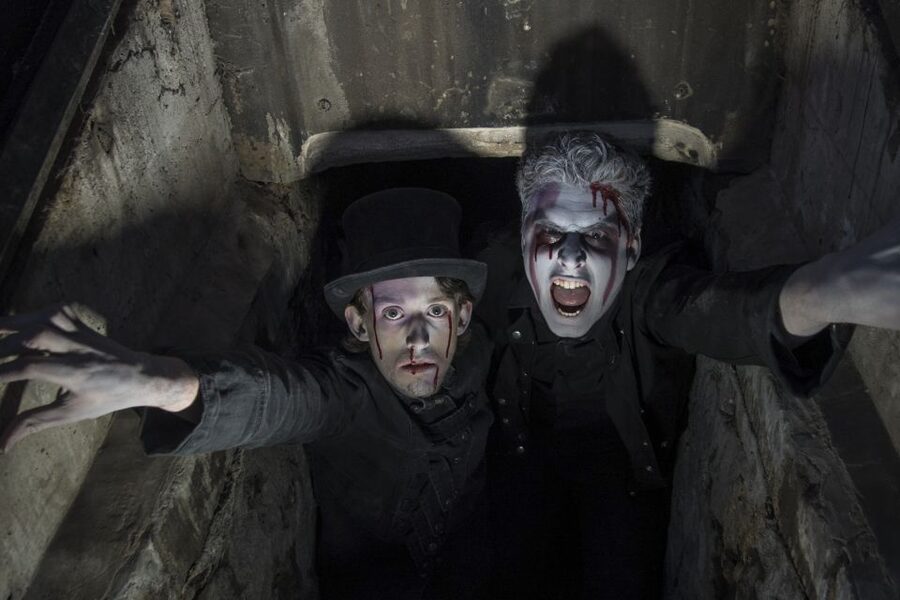
Now we get to the main event: The Dead House.
The underground morgue sits within the quiet surroundings of the Church of Our Lady and St Nicholas. The tour describes it as a place that has remained closed to the public for more than a century, and you’ll enter at your own risk because it’s not a public museum space in the normal sense.
Here’s what you’ll learn during the build-up and the actual entry. The site is tied to how Liverpool dealt with death in earlier centuries, including the idea that locals could peer through grim iron grates at the faces of the deceased in the 18th and 19th centuries. The tour also points out that the space was used as a temporary police station during World War II.
You’ll also hear about why it carries the name tied to American literature. Hermann Melville named it the Liverpool Dead House, and that name helps turn the story from local rumor into something that traveled beyond the city.
Mechanically, what to expect is a staged descent. You’ll end up at the boundary of a medieval garden, tucked beneath a Gothic spire, and you enter through a trapdoor. The atmosphere shift is the point. It’s not about comfort. It’s about getting your senses aligned with the story.
Torch required, and why that rule is part of the experience
You must bring your own torch. It’s explicitly required for the tour, and it makes sense once you think about the setting. Underground spaces and staged drama rely on controlled light, so your torch is basically your key to moving safely and participating fully.
The tour also gives you a clear warning: the underground location is not open to the public, and participants enter at their own risk. That’s not just legal language. It’s telling you the space is functional and atmospheric, not designed like a modern wheelchair-friendly attraction.
This is also why the tour is not recommended for people with limited mobility, the visually impaired, or anyone who feels easily distressed. The staging can include unsettling mood and grim subject matter.
If you’re going with a group, plan for a simple division of roles: one person in charge of the torch, everyone else watching where the guide leads. It makes a big difference for flow, especially when you’re going up and down steps.
Family-friendly with limits: adults, kids, and what not to bring
Despite the gruesome subject, the tour is described as family-friendly, but it comes with adult supervision rules for children. Unaccompanied minors are not allowed, so bring an adult for any kids in your group.
It’s also not a good fit for everyone in the family. The tour is described as not recommended for those of a delicate disposition, which is a polite way to say the topic can be intense, even if the telling style includes humor.
The practical list you should take seriously is short but important:
- No torch, no tour access
- No smoking, including vapes and e-cigarettes
- Strictly guide dogs only
- Not wheelchair accessible
If you have mixed ages or mixed comfort levels, consider whether adults will be okay with the underground part while kids or sensitive family members stay comfortable with the walking and storytelling segments.
Is it good value at $26 for an underground morgue experience?
At $26 per person for about 1.5 hours, the price feels reasonable once you factor in the main draw: exclusive access to a closed subterranean morgue plus guided theatrical performance.
Most city tours give you information and photos. This one adds a physical, spatial experience underground. That pushes the value from “good stories” to “stories you can stand inside.”
The guides also seem to be a major strength. The performances tend to be funny and professional, with a double-act dynamic that keeps momentum through each scene. People also mention the drama leading up to the dead house, and the way the atmosphere is staged once you reach the steps.
If you’re choosing between a standard walking tour and this one, I’d pick this if you want something more character-based and you’re okay with darker themes. If you want a light, family-only stroll with zero tension, you may prefer a less theatrical option.
Should you book the Liverpool Dead House theatrical history tour?
Book it if you want an unforgettable Liverpool night that mixes street theater, major landmarks, and a true underground site. I think it’s especially worth it if you enjoy guided storytelling that uses humor, staging, and pacing rather than reading plaques.
Skip it or rethink if any of these apply:
- You need wheelchair access, or you expect to manage uneven steps and confined underground areas
- You’re traveling with someone who is easily distressed by gruesome topics
- You forgot (or don’t want to carry) a torch
- You’re hoping for constant ghost-style scares with lots of pure paranormal action
If you do book, show up ready to play along. Bring your own torch, wear shoes that can handle steps, and let the guide run the scene. In return, you get a Liverpool experience that feels like history you can walk through, then step into.
FAQ
How long is the tour?
The tour duration is about 1.5 hours.
Where does the tour start and end?
It starts at the Queen Victoria Monument, Derby Square, Liverpool and finishes at 5 Old Churchyard, Liverpool L2 8GW, UK.
Do I need to bring a torch?
Yes. You must bring your own torch, especially for the underground portion.
Is The Dead House open to the public?
No. The underground location is not open to the public, and participants enter at their own risk.
Can unaccompanied minors join?
No. Unaccompanied minors are not allowed, and children must be accompanied by an adult.
Is the tour wheelchair accessible?
No. The tour is not wheelchair accessible, and it is not recommended for those with limited mobility.
Newly listed near Liverpool
- Liverpool: The Beatles Tour on Electric Pedal-Assist Ebikes★ 5.0 · 17 reviews
- Liverpool: Upside Down House Entry Ticket★ 4.0 · 168 reviews
- Liverpool: 1980s Music Walking Tour with Guitarist “Nasher”★ 5.0 · 6 reviews
- Liverpool: The Beatles and Cavern Quarter Walking Tour★ 4.7 · 133 reviews
- Liverpool: Total Beatles Car Tour Casbah & Cavern Clubs★ 5.0 · 3 reviews
- Liverpool: The Beatles and Waterfront Guided Walking Tour★ 4.7 · 51 reviews
- Liverpool: The Anfield Abseil & Liverpool FC Museum★ 4.8 · 117 reviews
- Liverpool: Quirky Quarter Interactive Museum Entry Ticket★ 4.7 · 90 reviews
Historical Tours, compared.



Browse the lists this tour appears in